

Leading China Container House Steel Frame Forming Machine Manufacturer
2026-10-23
When a shipping container becomes a home, the steel frame inside decides how long it stands. That’s where Beenew comes in. As a leading China container house steel frame forming machine manufacturer, Beenew turns cold-rolled steel into precise, load-bearing frames for modular living spaces. In this post, we’ll break down why frame quality matters more than you think—and what to look for before you invest in a roll forming line.
How We Build Container House Steel Frame Lines That Last
Our frame lines start with cold-formed steel that gets milled to exact tolerances on our own roll formers. Instead of cutting corners with off-the-shelf channel, every stud and track is punched, notched, and pre-drilled before it reaches the assembly floor. That means the skeleton of each container house goes up square and stays square, even after repeated transport and site-level adjustments.
We weld the corner castings and base rails using full-penetration passes, then run a zinc-rich primer and a powder topcoat over every joint. The frame is then pulled through a three-axis jig to check diagonal drift—anything beyond 2 mm gets reworked on the spot. This is the part most builders skip, but it’s why our steel lines don’t develop hairline cracks at the welds or loosen around door openings over time.
Inside Our Roll Forming Process for Steel Frame Profiles
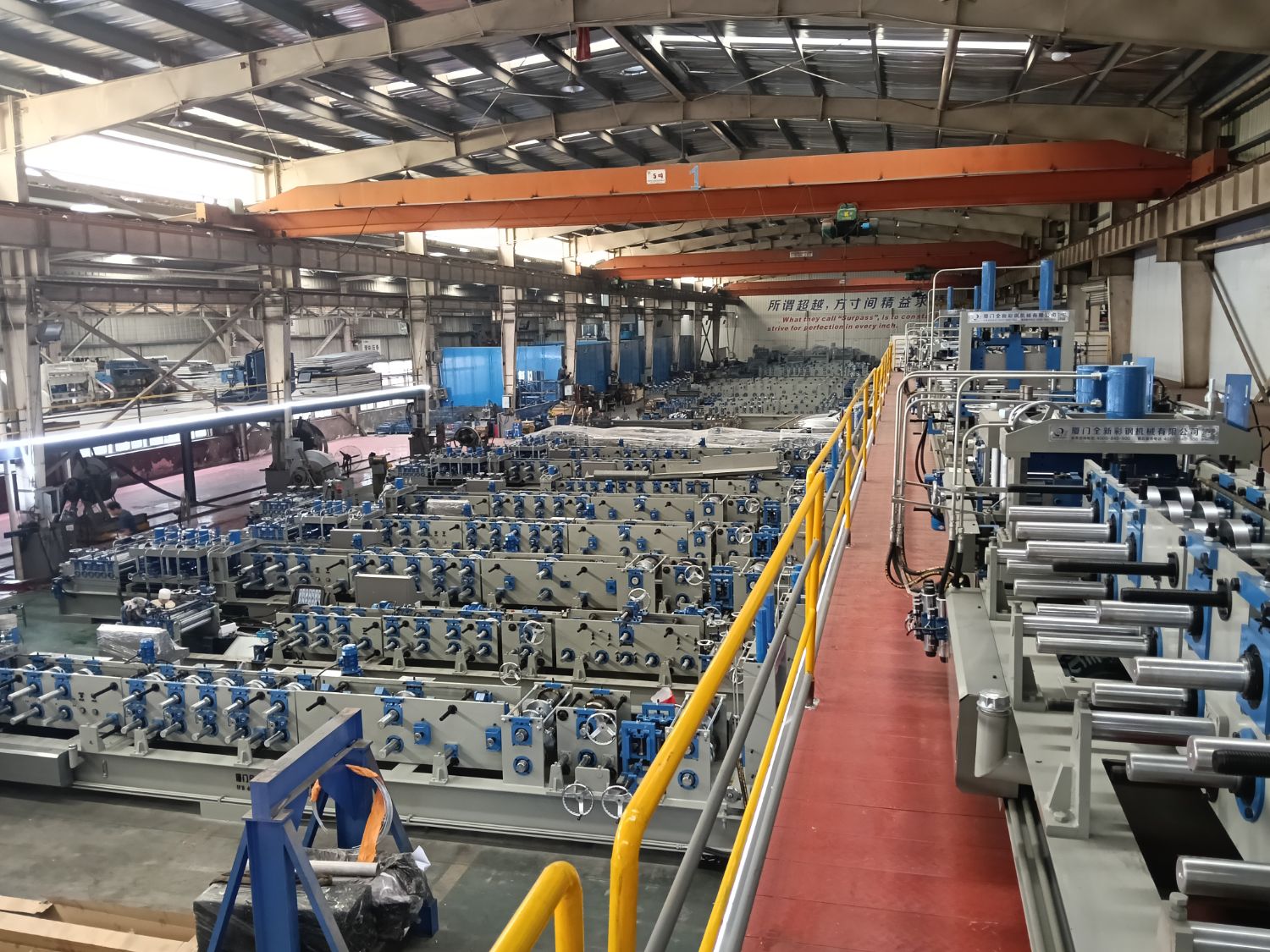
We start with coiled steel, not pre-cut blanks, and feed it through a sequence of stations where each roll set makes a small, deliberate change. This gradual shaping is what keeps the profile from warping or springing back later.
Depending on the profile, we also punch holes, notch flanges, or emboss features while the steel is still moving through the line. Servo-driven stops and laser sensors keep these features within a fraction of a millimeter, so the final stud or track drops into assembly without rework.
At the exit, a flying shear or saw cuts each piece to length without slowing the line, and an automatic stacker groups identical lengths. Random samples are checked against a master profile and measured for twist, camber, and flange width before they go to the warehouse.
Custom Machine Configurations for Container Home Factories
Building container homes at scale rarely works well with off-the-shelf equipment. Factory layouts, material handling flows, and the mix of steel gauges you cut each week all push toward customized machine setups. A plasma cutting table might need a longer rail for 40-foot high-cube panels, while a roll former could be paired with an inline notcher to skip a secondary punching step. These choices are not about adding bells and whistles; they are about removing the bottlenecks that show up after the first hundred units.
The most useful custom configurations usually start with a clear bottleneck list from the shop floor. One factory might fight warped framing because the stud and track stations are too far apart, so a combined punching and shearing line makes sense. Another might run mostly single-module builds and can use a shorter, heavier press brake with tandem controls. The goal is to match machine travel, tooling, and automation to the actual container sizes and connection details you use, not to a generic catalog spec.
We often see smaller factories overpay for speed while ignoring setup time. A custom line that lets operators switch between 20-foot and 40-foot profiles without re-zeroing guides saves more labor than a faster spindle. Likewise, integrated lifting and flipping stations can turn a two-person panel handling job into a one-person flow. The real payoff is a line that fits your floor space, your crew’s skill level, and the repeat work you actually bid on.
Why Builders Choose Our Steel Frame Forming Equipment
On a jobsite, time lost to finicky machinery isn't just an inconvenience — it's money walking off the lot. Our steel frame forming equipment earns its place because it starts when you need it and keeps going until the last profile is cut. The rollers are machined to hold tight tolerances run after run, so a Monday morning coil change doesn't turn into a half-day of shimming and cursing. Builders who have been burned by flimsy imported lines tell us the difference shows up in the small things: gauges that read true, guides that don't wander, and a control panel that doesn't require a manual every time you switch from stud to track.
What really seals the decision is how the machine adapts to the way crews actually work. You can dial in a new web width without breaking out a wrench set, and the quick-change shear lets one operator handle drops that used to need two. We've had framing contractors run our equipment side by side with their old roll former and watch the scrap pile shrink by a third — not because of some magic setting, but because the feed path keeps the strip flat and the cutoff lands square. When you can trust the output, you stop cutting extra pieces 'just in case,' and that changes how you bid the next job.
Support matters long after the crate is opened, and that's where a lot of builders get left hanging. We keep common wear parts on the shelf and answer the phone when your line is down — not with a ticket number, but with someone who knows which bolt to check first. The frame is built heavy enough that you're not chasing alignment every spring, and the powder coat survives the back of a flatbed without flaking off in sheets. It's not the flashiest pitch, but builders stick with our equipment because it shows up ready, runs boringly consistent, and doesn't invent reasons to stop on a Friday afternoon.
Precision Engineering Behind Every Profile We Ship
Every profile that leaves our floor has to survive a gauntlet of checks that starts long before the first extrusion run. We hold wall thickness to within ±0.15 mm, and we verify it with laser calipers at three points along each length—not just at the ends where problems are easy to hide. The die design gets reviewed against thermal expansion data from previous batches, so what you receive matches the drawing instead of being close enough.
That same attention carries through cutting, drilling, and finishing. Our CNC stops recalibrate every 40 cycles, and operators log the actual measured values, not a checklist checkbox. If a batch drifts by more than 0.05 mm from target on any feature, it gets quarantined and reworked before packaging. It slows us down, but it means the profile you install won't fight the connector, the gasket, or the next section in line.
Packing matters too. We don't rely on generic foam and hope. Each bundle is braced to prevent twist during transit, and we include a QC trace slip with the actual measurements from your run. That way you're not trusting a promise; you're holding the numbers.
From Coil to Completed Steel Frame: What to Expect
A coil of galvanized steel arrives at the framing facility looking unremarkable—just a tightly wound roll weighing a few tons. From there, it goes through a decoiler and straightener, which removes the curve and feeds a flat, consistent strip into the production line. This is where the steel's thickness and coating are checked against the project's structural requirements before any cutting begins.
Next come the punches and notches. Hydraulic presses cut out service holes for electrical and plumbing runs, and small tabs or slots that will help the frame members lock together later. The strip then moves through a roll former, which bends the flat steel into C-shaped studs or U-shaped tracks. A flying shear cuts each piece to the exact length specified in the shop drawings, often within a sixteenth of an inch.
The final stage is assembly and inspection. Cut studs and tracks are bundled by wall section, labeled, and sometimes pre-assembled into panels on a framing table. Welders or screw fasteners join the corners, and diagonal bracing is added where the design calls for shear resistance. Before the completed frame leaves the facility, it is checked for squareness, hole alignment, and overall dimensions against the approved submittals.
FAQ
Our machines roll C, U, Z, and custom profiles from galvanized steel coils, with widths from 80mm to 300mm and thickness up to 2.5mm. The interchangeable roller sets allow switching between profiles in under an hour.
We use servo-driven feeding and a closed-loop PLC system that monitors each pass. This keeps length accuracy within ±0.5mm and twist below 1mm per meter, which is critical for container modules that need to stack and align correctly.
Absolutely. The gearboxes and hardened rollers are rated for yield strengths up to 550 MPa, so you can run thinner, lighter sections without sacrificing frame rigidity. This often cuts steel consumption per unit by 8–12% compared with conventional mild steel designs.
Depending on profile complexity, the line runs at 15 to 25 meters per minute. For a standard 20-foot container frame, that translates to roughly one complete set of main beams and columns every 6 to 8 minutes with automatic cutting and punching.
We supply the full coil handling, leveling, punching, roll forming, and automatic stacking equipment. We also offer layout drawings, foundation requirements, and on-site commissioning support, so you can start production with minimal trial and error.
The control system stores recipe parameters for each profile and length. Operators simply select a saved job, and the machine adjusts roller positions, punch patterns, and cut lengths automatically. Manual changeover is rarely needed except when swapping roller sets for a completely different profile.
Each machine is assembled and run with customer-supplied coil samples before disassembly. We check profile dimensions, hole positions, cut squareness, and surface finish, and provide a full test report with video documentation. Only after all points pass do we crate and ship.
Conclusion
Behind every container home that stands up to harsh weather and daily wear is a steel frame built on equipment designed to endure. We approach each production line as a long-term asset: frames are cut, punched, and rolled on heavy-duty stations with servo-driven accuracy, while the roll forming sequence is tuned to keep profile dimensions consistent from the first meter to the last. Rather than treating every order the same, our engineers review your target profiles, material thickness, and factory layout before recommending the right number of stands, hole patterns, and cutting methods. That attention to detail carries through to the finished machine—each one is tested with actual coil before shipping, so what arrives at your site is ready to run, not a project waiting to be debugged.
Container home factories often deal with tight tolerances and mixed production runs, which is why our equipment supports quick changeovers and adjustable forming passes for common stud, track, and corner profiles. Builders keep coming back because the machines hold their calibration and rarely demand unexpected downtime; when support is needed, spare parts and remote guidance are handled by people who know the line, not a scripted call center. From uncoiling and leveling to punching, shearing, and final stacking, the journey from raw coil to a completed steel frame is designed to be predictable. That predictability is what lets a busy factory schedule confidently and deliver container houses on time, without compromising frame geometry or weld alignment.
Contact Us
Contact Person: Sophie
Email: [email protected]
Tel/WhatsApp: 8615959271231
Website: https://www.beenew-rollformer.com/